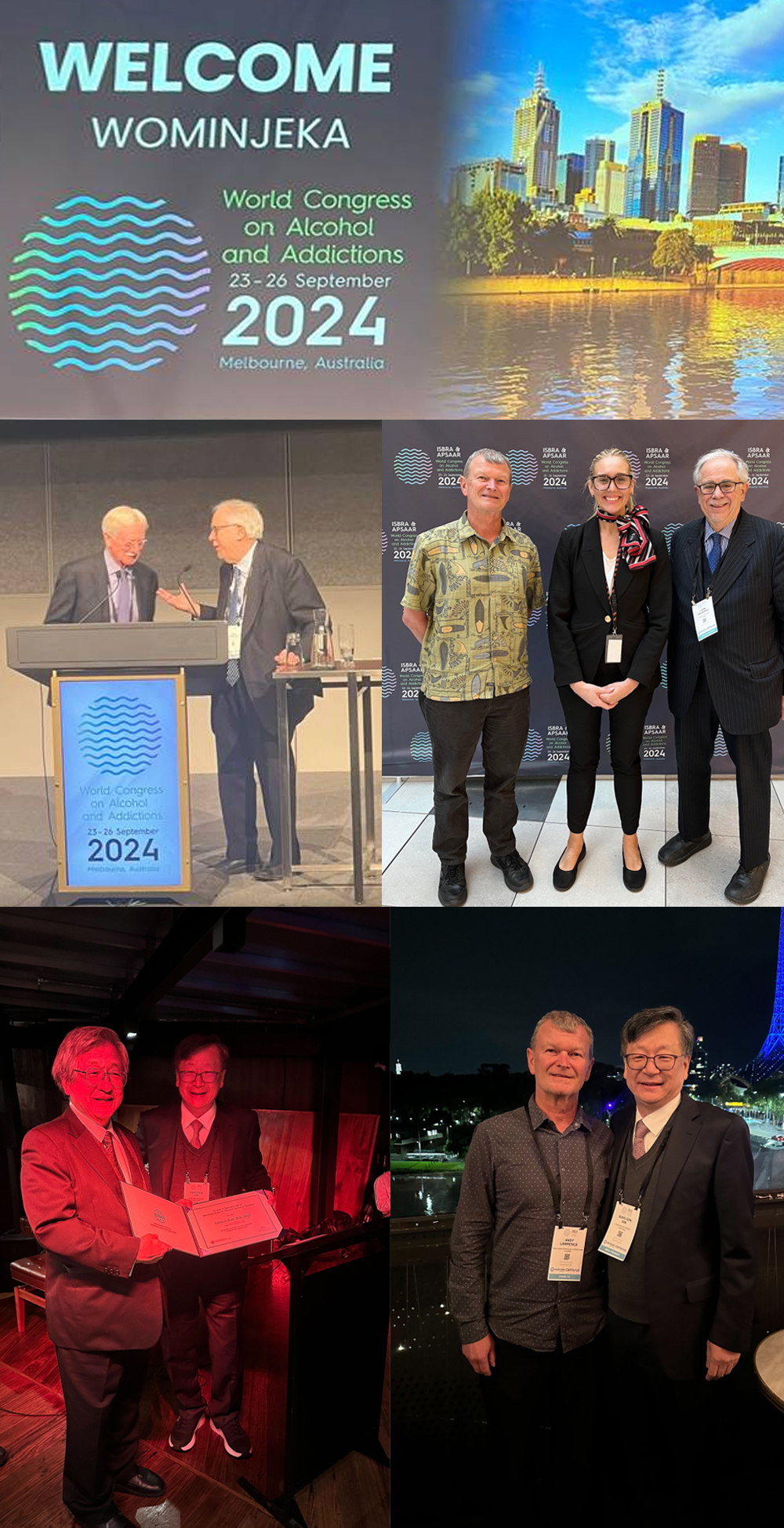
We are delighted to report on the success of the ISBRA-APSAAR World Congress on Alcohol held in Melbourne (September 23-26, 2024)
A summary of the congress together with images of the meetings are available here.
In September 2024, Melbourne welcomed the ISBRA -APSAAR 2024 World Congress on Alcohol and Addictions, which was held at the Convention Centre. John Saunders (Universities of Queensland and Sydney) and Andrew Lawrence (Florey Institute, Melbourne) were Congress President and Vice President respectively. As an International conference, the World Congress rotates between different regions of the world. Indeed, this was its first visit to Australia for nearly 20 years.
The Congress was co-sponsored by the World Health Organization, a rare honour, which reflects that ISBRA has had official relations as a non-state (professional) organisation with WHO for the past 30 years. It is frequently sought out by WHO for its expertise and support for WHO’s policies and programs on a range of substance use disorders and behavioural addictions.
530 scientists and clinicians from 32 countries participated. Large overseas contingents came from the US, Japan, South Korea, Thailand, and many European countries and also colleagues from Africa and South America.
The single word most commonly used by participants to describe the Congress was “fantastic”. The program included 16 plenary and keynote talks (listed in Table 1) given by leading experts. There were 60 symposia, together with sessions for early career investigators and practical sessions oriented to clinical treatment and recovery. In addition, there were 75 free oral presentations and a similar number of poster demonstrations. Our overseas guests were headed by Dr. George Koob, the Director of the US National Institute on Alcohol Abuse and Alcoholism (NIAAA). T
he conference was structured around several streams:
• The first thousand days of life (including foetal alcohol spectrum disorder)
• Epidemiology, public health and prevention
• Neuroscience and pharmacology
• Organ damage
• Treatment
• The addictive disorders spectrum
• Opioid use disorders and their treatment
• Gambling and video gaming
Of course much of the value of an international conference is in sharing findings and experiences of our research and its applicability to clinical practice. There was an audible buzz around the Melbourne Convention Centre as people were discussing projects, forming linkages and canvassing potential grant applications.
The conference also provided the opportunity for non-government organisations and those with lived experience of substance use disorders and addictions, who were encouraged to host symposia and were provided with displays for a small fee or free or charge.